
How to Get Tutoring Clients and Keep the Families Who Inquire
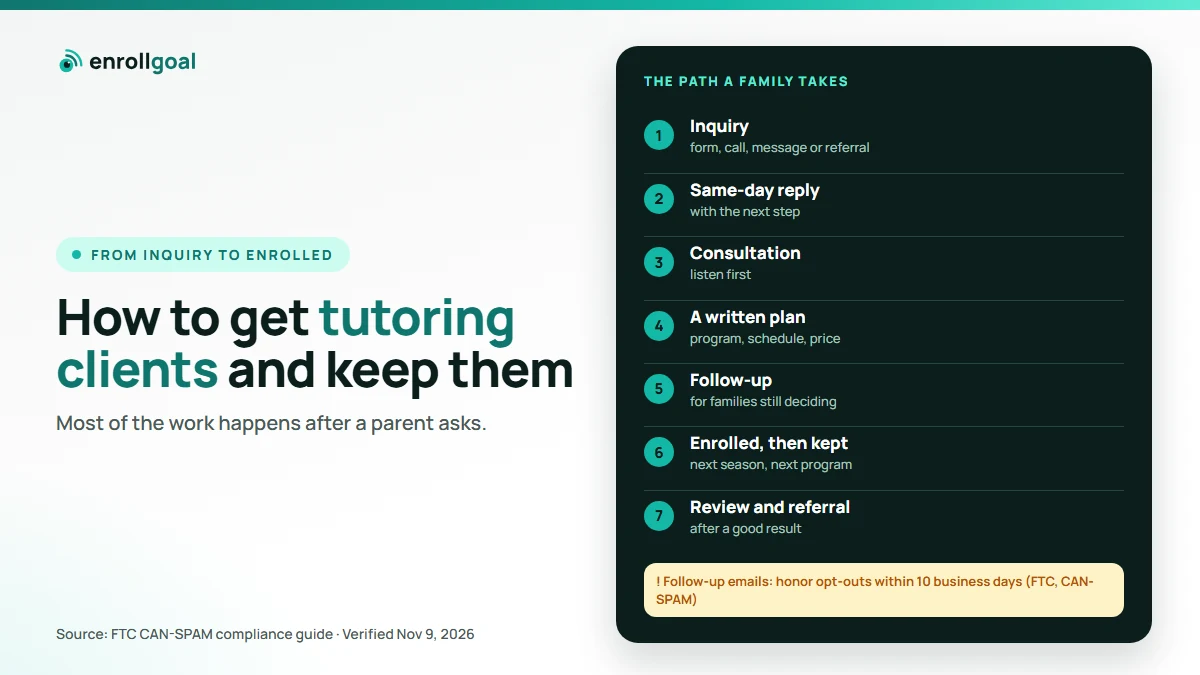
A tutoring business gets clients in two stages: parents find you, and then you win the inquiry. The second stage is the one you control, and it's where an inquiry you already worked for can slip away. To win it, reply the same day, start with a short consultation, propose a plan tied to the child's goal and a date, and follow up with families who haven't decided. Then keep each family for the next stage of school.
Most advice on this search stops at finding a first student. This guide is for tutors and tutoring businesses of any size, working alone or with staff, who already get inquiries and want more of them to become enrolled families, and more of those families to come back. Marketing a tutoring business is half finding families and half winning them. This post is the second half.
Key takeaways
- The inquiry is the expensive part. Every channel you pay for, in money or time, ends in one, so answer it the same day.
- Start with a consultation that finds the child's need, not a sales pitch.
- Propose a plan with a goal, a date and a weekly shape, not open-ended hours.
- Promotional follow-up emails fall under the US CAN-SPAM Act: honest subject lines, your postal address, and an opt-out you honor.
- Plan the next program before the current one ends. A family you already know already trusts you, which makes them the easiest family to keep.
Where new tutoring clients come from
Parents find tutors in five places: Google search and Maps, other parents, their child's school, local parent groups, and AI assistants such as ChatGPT. Paid ads can add reach to any of them. Each one is covered step by step in our guide on how to advertise tutoring services.
This post starts where that one ends: the moment a parent fills in your form or calls. Whatever brought them, what happens next decides whether they enroll.
1. Make it easy to inquire
A parent who has decided to ask should be able to do it in under a minute, from any page of your site. Put one short form and a phone number on every page, not only on the contact page.
Ask only what you need to reply well:
- the child's grade
- the subject or exam
- what the parent wants (a grade, a score, a school, confidence)
- the best way and time to reach them
Every extra field is a reason to leave. Pricing questions, how they heard of you and the child's full history can wait for the consultation. Our website service builds every page around one obvious way to get in touch for exactly this reason, and our tutoring website examples show what goes on each page.
2. Reply the same day
A parent who inquires is usually comparing options, and may have written to other tutors the same evening. A clear answer that day keeps you on their list. Of everything in this guide, a same-day reply takes the least effort.
If you can't call back the same day, send a short reply that says when a person will call, and keep that promise. An automatic email that only says "we received your message" doesn't do this job. A parent wants to know when they'll hear from someone, and who.
A good first reply does three things. It answers the question the parent actually asked, says what happens next (usually a short call or a diagnostic), and offers two or three times for it. If replies slip while you're teaching, that's the gap our parent follow-up service is built to close.
3. Start with a consultation, not a sales pitch
A short consultation, by phone or with a diagnostic test, does two jobs. It shows you what the child needs, and it shows the parent that you understand it. Both have to happen before a plan makes sense.
Keep it about the child. Ask what's going on at school, what has been tried, and what the deadline is: a test date, a report card, an application. Say what you'd look at first, and what happens after the call.
4. Propose a plan tied to a goal and a date
After the consultation, propose a plan, not a block of hours. A plan names the goal, the date it's for, and what the family gets each week until then. It's easier for a parent to say yes to "twelve weeks to the test, two sessions a week, a practice test every third week" than to "$X an hour, as many hours as you like".
For an exam with a fixed test date, work back from that date. For school subjects, tie the plan to the next report card or the end of the term. Either way, the parent can see when it ends and what success looks like.
Send the plan in writing the same day or the next, while the conversation is fresh.
5. Follow up with families who didn't decide
Many families don't say yes or no after the consultation. They go quiet. Follow up twice, a few days apart, with something useful each time: an answer to a question they raised, or a reminder of the date that matters. After that, stop chasing. Send one useful note before the next deadline in their child's year instead.
Follow-up email has rules. In the US, the CAN-SPAM Act covers commercial email, meaning messages whose main purpose is to promote a product or service. The FTC's CAN-SPAM compliance guide for business sets out what such messages need, including:
- header information that isn't false or misleading, and a subject line that isn't deceptive and reflects what the message is about
- a clear statement that the message is an advertisement
- your valid physical postal address
- a clear and conspicuous way to opt out, which must work for at least 30 days after you send, with opt-out requests honored within 10 business days
Some messages, such as confirming a booking a family has already agreed to, count as transactional or relationship messages and are exempt from most of these rules. The FTC says it views those categories narrowly, and that the message's primary purpose decides which kind it is. Don't assume a follow-up is exempt because the family once inquired: if it's mostly promotion, treat it as commercial email. Text messages follow different rules; this section covers email only.
6. Keep families after the first program
The steadiest way to grow a tutoring business is to keep the families you already teach. Children move through school in stages, and each stage brings a new need: an admissions test, then high school courses, then the SAT or ACT, then college applications. A family that trusts you with one stage already knows how you work, so raise the next stage before they go looking.
Have the re-enrollment conversation before the current program ends, not after. Tell the parent what comes next for their child and when it starts, and offer to plan it.
7. Turn results into reviews and referrals
When a child does well, that's the moment to ask for a review and a referral, not at sign-up. Make both easy: send your Google review link, and a short message the parent can forward to a friend. Don't offer anything in return for a review; Google treats that as fake engagement under its prohibited content policy. Step 3 of our guide to advertising a tutoring business covers the timing of referrals in more detail. If the family agrees in writing, a result can also become a post; our tutoring social media post ideas cover how to share one.
Track every inquiry on one sheet
You can't fix the stage where families drop off if you can't see it. Keep one sheet with a row for every inquiry:
| Inquiry date | Source | Replied | Consultation | Plan sent | Enrolled | If not, why |
|---|---|---|---|---|---|---|
| (date) | Google, referral, ad... | Same day? | Yes / No | Yes / No | Yes / No | Price, timing, chose another tutor, no reply... |
Fill it in as you go. When the sheet stops keeping up, our guide to choosing a tutoring CRM covers what to move to. After a season, the sheet answers the questions that matter: which sources bring families who enroll, how fast you really reply, and where families stop. That tells you whether to spend more on advertising or on answering.
Where EnrollGoal fits
We built EnrollGoal after inquiries to HighScores.ai, our own test-prep platform, came in while we were teaching, and too often nobody followed up. In pilot, it replies to every inquiry and follows up with families, with the opt-out that commercial email needs. We also keep your website and inquiry form current, and write the pages that bring parents to you through Google and AI search. A person on our team reviews every page and every email template before it goes live; the same-day reply then goes out automatically.