
How Parents Find Tutors on Google and ChatGPT
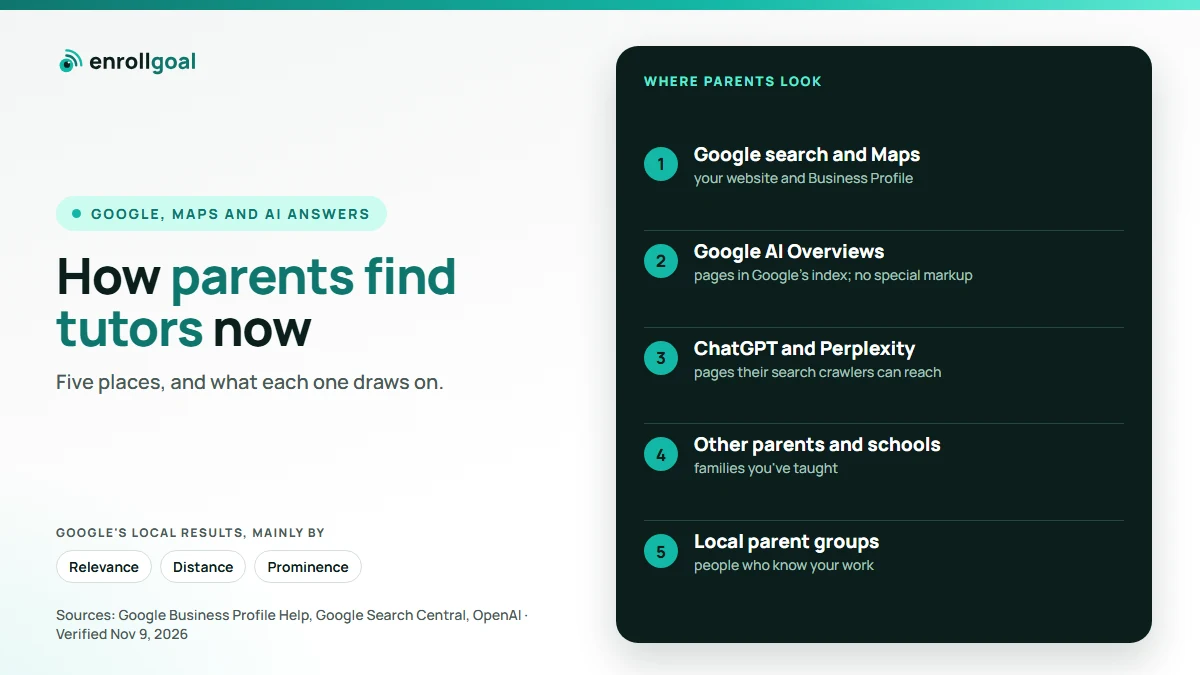
Parents find tutors in five places: Google search and Maps, other parents, their child's school, local parent groups, and AI tools such as Google's AI answers, ChatGPT and Perplexity. This guide covers search and AI. Google says its AI answers need no special markup, and neither OpenAI's nor Perplexity's crawler documentation asks for any. The same few things help in all of them: your website, your Google Business Profile, your reviews, and what other sites say about you.
Much of what's written about "getting recommended by ChatGPT" comes from agencies, and some of it says you need special code or files. This guide sticks to what Google, OpenAI and Perplexity say in their own documentation, applied to a tutoring or test-prep business, and says plainly where they don't say.
Key takeaways
- Google picks local results mainly by relevance, distance and how well known a business is. You can't pay for a better local ranking.
- Google says AI Overviews and AI Mode need no special optimization: a page must be indexed and eligible to show in Search with a snippet.
- ChatGPT and Perplexity each run a search crawler. OpenAI says a site that blocks its search crawler won't be shown in ChatGPT search answers.
- Clear program pages, consistent business details and reviews that name what you teach are the best-documented things to work on.
Where parents look for a tutor now
A parent looking for a tutor usually starts with a question. "SHSAT prep in Queens." "Math tutor near me." "Who's the best ISEE tutor in Brooklyn?" They type it into Google, ask an AI tool, or ask other parents.
| Where the parent asks | What they see | What it draws on |
|---|---|---|
| Google search | A list of links, often with a map of local businesses | Your website, your Google Business Profile |
| Google Maps | Businesses near them, with ratings | Your Google Business Profile and reviews |
| Google AI Overview or AI Mode | A written answer with links | Pages in Google's index |
| ChatGPT or Perplexity | A written answer | Pages their search crawlers can reach, and other sources they don't fully document |
| Other parents, schools, parent groups | A name and a phone number | Families you've taught and people who know your work |
The last row is covered in our guide on how to advertise tutoring services. This guide covers the first four.
How Google picks local tutoring results
Google says local results are based mainly on three things (Google Business Profile Help):
- Relevance: how well your profile matches what the parent searched. A profile that lists "SHSAT prep" as a service is a closer match for "SHSAT prep" than one that says only "tutoring".
- Distance: how far you are from the parent, or from the place they searched.
- Prominence: how well known your business is. Google says this draws on information such as how many websites link to you and how many reviews you have, and that more reviews and positive ratings can help.
Google also says there's no way to request or pay for a better local ranking. So the work is the same for everyone: a complete profile that names each program, a steady flow of real reviews, and a website that other local sites have reason to link to. Our advertising guide's first step covers setting up your Google Business Profile, and our guide on how to get tutoring clients covers turning results into reviews.
What Google's AI answers require from a page
Google's AI Overviews and AI Mode write an answer with links to pages. Google says there are no additional requirements to appear in them, and no special optimization or structured data needed. A page has to be indexed and eligible to show in Google Search with a snippet, and the usual SEO practices apply (Google Search Central, AI features and your website). If you do use structured data, Google says it should match the visible text on the page.
For a tutoring business, that means a program page that's indexed and eligible for a snippet is one Google's AI answers can use. A page that clearly says what you teach, for which grades, where and when, gives them something to quote.
How ChatGPT and Perplexity reach your website
ChatGPT and Perplexity each run a search crawler that visits websites. Two are worth knowing:
- OAI-SearchBot, OpenAI's crawler for ChatGPT search. OpenAI says sites that opt out of it will not be shown in ChatGPT search answers, and it recommends allowing it. Its training crawler, GPTBot, is a separate setting: OpenAI says each one is independent of the others (OpenAI, overview of OpenAI crawlers).
- PerplexityBot, which Perplexity says is designed to surface and link websites in its search results, and is not used to train AI foundation models (Perplexity, crawlers).
Whether these crawlers may visit your site is set in a file called
robots.txt, at your domain followed by /robots.txt. Open yours. If it
blocks OAI-SearchBot, OpenAI says your pages won't be shown in ChatGPT search
answers, however good they are. Perplexity says PerplexityBot is designed to
surface and link websites in its results, so blocking it is likely to work
against you there too.
Website platforms, hosting and security tools can change this file, or block
crawlers with their own bot settings before the file is read, so check both
even if you never changed anything. If you'd rather keep your pages out of
OpenAI's model training, you can block GPTBot and still allow OAI-SearchBot.
Allowing the crawlers makes you eligible. It doesn't guarantee a mention. OpenAI and Perplexity don't publish how their answers choose which businesses to name. What Google documents for its own results (relevance, how well known you are, reviews, links from other sites) is the best-documented guide, and it's the same work.
What to work on, for Google and AI answers
AI answers are more likely to get you right when your details are easy to find and agree with each other. This checklist covers the same ground for Google, its AI answers, ChatGPT and Perplexity:
| What to have | Why it helps | Where |
|---|---|---|
| One page per program, naming the exam or subject, grades, place and format | It matches the question a parent asks | Your website |
| The same business name, address or service area, and phone everywhere | It's clear it's one business | Website, Google Business Profile, directories |
| A complete Google Business Profile with each service listed | It feeds local results | |
| Real reviews that say what the child studied | They show what you teach, in a parent's words | Google and other review sites |
| Current dates and prices, or a starting point | Out-of-date pages are poor answers | Program pages |
| Search crawlers allowed | Their crawlers can reach the pages | robots.txt and your host's bot settings |
| Mentions on other local sites | Others vouch for you | Schools, libraries, local news, parent groups |
None of this is new. It's what has always helped a tutoring business be found. An AI answer is a short written summary, so the businesses it names get the parent's attention. Our tutoring website examples show what a program page should say.
How to check what AI tells parents about you
You can check what AI tools say about your business in a few minutes:
- Write down five questions a parent would ask, in their words: "Best SHSAT tutor in Queens", "ISEE prep for 7th grade near Forest Hills", "Is [your business] any good?"
- Ask each one in ChatGPT, Perplexity, Gemini and Claude, and in Google (look at the AI Overview if there is one).
- Note who's named, whether you are, and which pages are linked.
- Check what's said about you is right: programs, place, prices.
- Repeat monthly. Answers change, and can differ between people and sessions, so look for a pattern over a few months rather than one result.
If competitors are named and you aren't, look at the pages linked in the answer. They suggest what the tool found useful, and what you may be missing.
Where EnrollGoal fits
Our Google and AI search service does this for you. On every paid plan, each month we check whether ChatGPT, Perplexity, Gemini and Claude name your business for the searches parents use, and we add the pages that help them do it, timed to your exam calendar. We also fix the pages Google misreads, and send you one plain report. If your inquiries need a home once parents find you, our guide to choosing a tutoring CRM covers it.